
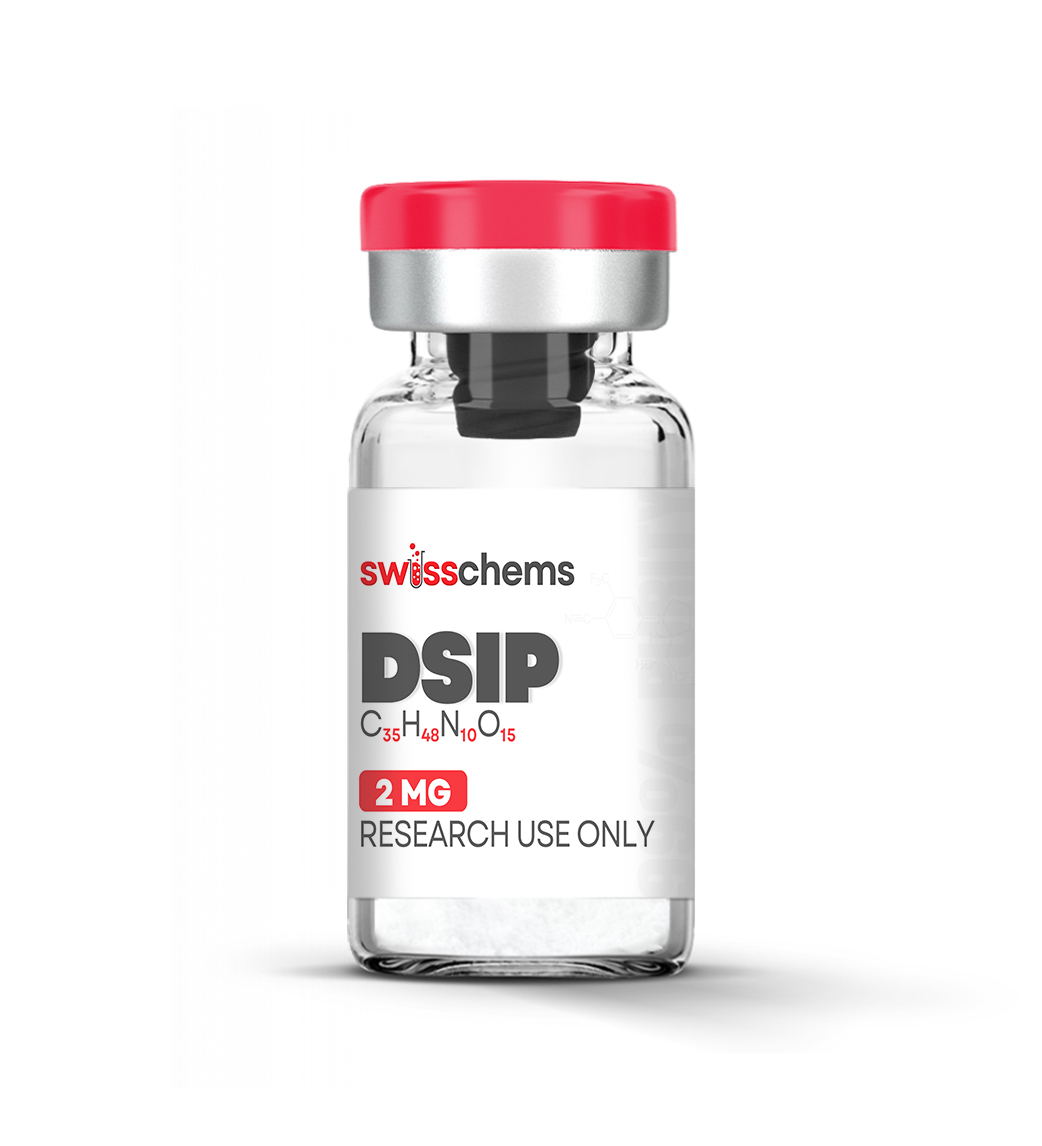
Delta-Sleep-Inducing Peptide (DSIP): Science-Backed Overview, Benefits & Research Insights
Delta-Sleep-Inducing Peptide (DSIP) is a naturally occurring neuropeptide first isolated from the cerebral venous blood of rabbits in the 1970s. It consists of nine amino acids (a nonapeptide) with the sequence Trp-Ala-Gly-Gly-Asp-Ala-Ser-Gly-Glu. (Wikipedia)
DSIP has attracted scientific interest because of its potential role in sleep regulation, stress modulation, and broader neuroendocrine functions. Although it remains largely a research compound, its unique properties continue to be explored in both animal models and human experiments. (Wikipedia)
How DSIP Works: Mechanism & Biological Actions
Unlike traditional sleep medications that act on a single neurotransmitter system, DSIP appears to influence multiple neurophysiological pathways:
- Sleep EEG Modulation: When administered in rabbit brains, DSIP induces delta wave EEG activity associated with deep slow-wave sleep. (Wikipedia)
- Adrenergic Modulation: In animal studies, DSIP alters the response of alpha-1 adrenergic receptors in the pineal gland, affecting enzymes involved in circadian regulation. (PubMed)
- Hormonal Effects: Research suggests it may influence secretion of hormones such as luteinizing hormone (LH), corticotropin (ACTH), and potentially cortisol via neuroendocrine pathways. (Wikipedia)
- Melatonin & Serotonin Dynamics: DSIP has been shown to impact melatonin and serotonin synthesis in the pineal gland of rats, hinting at complex interactions with circadian and mood systems. (PubMed)
Although the exact receptor or full mechanism of action in humans remains unresolved, these multi-pathway interactions are the focus of ongoing neurobiological research. (Wikipedia)
Experimental Benefits Observed in Research
1. Sleep Regulation & Deep Sleep Enhancement
DSIP was originally identified because of its ability to enhance delta wave sleep, the deepest stage of non-REM sleep associated with restoration and memory consolidation. (Wikipedia)
- Some early human studies reported that DSIP infusion increased total sleep time and improved sleep efficiency, although results varied and weren’t uniformly strong. (PubMed)
- Other controlled trials showed improvement in REM and sleep structure without classic sedation, indicating DSIP may support natural sleep architecture rather than acting like a hypnotic. (PubMed)
However, these findings are preliminary and more study is needed to fully validate clinical effects.
2. Stress and Circadian Regulation
DSIP has been suggested to play a role in stress modulation and the body’s response to circadian rhythms:
- Animal research implies DSIP might reduce stress-related physiological responses and help stabilize daily metabolic cycles. (PubMed)
- Its interactions with neuroendocrine pathways — including potential effects on cortisol and other hormones — support interest in circadian and stress regulation beyond sleep alone. (Wikipedia)
3. Neuroprotective and Endocrine Effects
Some preclinical work points to broader biological roles such as:
- Antioxidant and metabolic activity at the mitochondrial level. (Wikipedia)
- Immune and hormonal balance, potentially affecting neurotransmitter networks and peptide signaling cascades. (Wikipedia)
These findings remain experimental and largely confined to laboratory models.
Clinical Research & Limitations
It’s critical to understand that DSIP is not approved by major health authorities for medical use, and its safety and efficacy in humans are not fully established. Studies have produced mixed results, and the peptide’s short half-life and stability challenges complicate research. (Wikipedia)
Many existing trials involve small sample sizes, variable dosing, and inconsistent protocols — meaning strong clinical recommendations cannot yet be made. (PubMed)
Research Use & Future Potential
DSIP remains a valuable tool in neuroscience and endocrinology research, helping scientists explore:
- Mechanisms of deep sleep and slow-wave activity
- Peptide interactions with neurochemical networks
- Links between sleep, stress, and metabolic regulation
Future research could clarify its potential in treating sleep disorders, stress dysregulation, and even neurodegenerative conditions — but rigorous clinical trials are essential. (PubMed)
Learn More
For peer-reviewed summaries and foundational research on DSIP, explore:
- Wikipedia’s overview of Delta Sleep-Inducing Peptide — structural and historical context. https://en.wikipedia.org/wiki/Delta-sleep-inducing_peptide (Wikipedia)
- PubMed articles on clinical sleep studies — objective and placebo-controlled evidence. https://pubmed.ncbi.nlm.nih.gov/?term=Delta+Sleep-Inducing+Peptide (PubMed)
Important Note
This description is intended for educational and informational purposes only. Delta Sleep-Inducing Peptide is a research molecule and should not be used outside of proper scientific or clinical study settings. Always consult qualified professionals when interpreting peptide research.
Reviews
There are no reviews yet.